
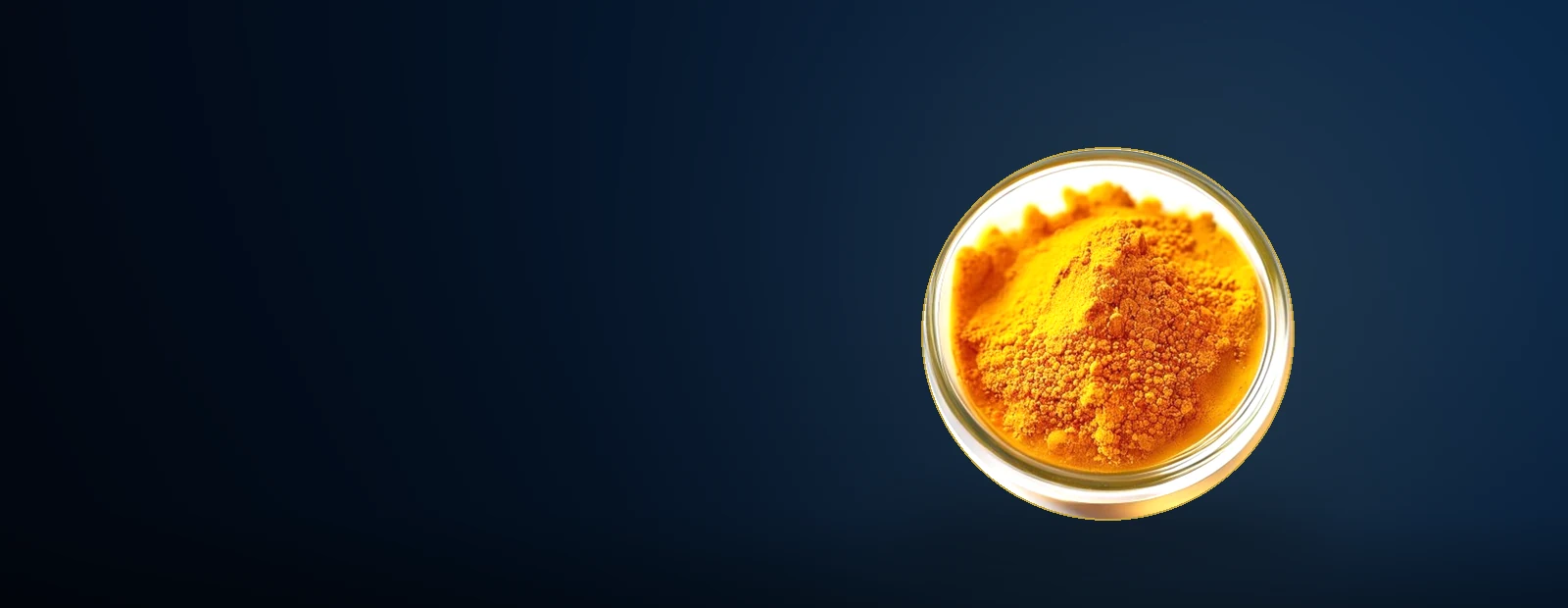
Turmeric Oleoresin (Curcuma longa)
The solvent extract you use when a formula needs colour and curcuminoids in one oil-friendly stream. Standardized from 20% to 40% curcuminoids, supplied as a dark orange viscous liquid for softgels, seasoning blends and fat-based food systems.
- Active: Curcuminoids 20–40% (HPLC)
- CAS: 8024-37-1
- Appearance: Dark orange to reddish-brown viscous liquid
- Packaging: 25 kg drum or 200 kg drum
What Turmeric Oleoresin Actually Is
Oleoresin sits between the raw rhizome and a purified 95% curcumin powder. Dried turmeric is extracted with a food-grade solvent, the solvent is stripped, and what remains is a resinous liquid carrying curcuminoids, volatile oils and the natural resin fraction of the root. Because the volatile oil stays in the product, oleoresin brings aroma and colour as well as curcuminoids — something a 95% extract cannot do.
That difference decides where each product goes. A capsule brand buying 95% curcumin wants the maximum active per milligram. A seasoning house, a cheese producer or a softgel formulator usually wants colour that disperses in fat, and may not need 950 g of curcuminoids per kilogram.
Key Facts at a Glance
- Curcuminoid content: 20%, 30% or 40% (HPLC), other levels on request
- CAS number: 8024-37-1
- Appearance: Dark orange to reddish-brown, viscous at room temperature
- Solubility: Oil-soluble and ethanol-soluble; not water-dispersible
- Volatile oil: Retained, typically 15–25% depending on grade
- Packaging: 25 kg epoxy-lined drum, 200 kg drum
- Shelf life: 24 months unopened, away from light and heat
Where the Grade Is Used
- Softgels and oil-based capsules. Dissolves directly in the oil phase, so no carrier or emulsifier is needed in the fill.
- Seasoning and snack coating. Carries both colour and the characteristic turmeric note, which is often what the application actually wants.
- Cheese, butter and fat-based spreads. The classic E100 colour route in dairy, with good light stability once dispersed.
- Pet food and treats. Used for colour and as a botanical component in premium lines.
- Cosmetics. Oil-phase antioxidant colourant in balms, soaps and creams.
How to Choose Between 20%, 30% and 40%
The number is a concentration, not a quality grade. A 20% oleoresin carries more oil and resin per kilogram, which is usually better for flavour-forward applications and easier to blend into a seasoning. A 40% grade puts more curcuminoids into the same drum, which reduces freight and storage cost per unit of active but makes the material thicker and harder to handle at room temperature.
Do the arithmetic on your own formula before choosing. If a softgel carries 100 mg of oleoresin at 30%, it delivers about 30 mg of curcuminoids. If the label needs 50 mg, you either accept a larger softgel or move to a higher grade. Buyers who compare only the price per kilogram often miss this step and end up with a formula that cannot hit its claim.
Quality & Specifications
- Assay: Total curcuminoids by HPLC, with the individual curcumin, demethoxycurcumin and bisdemethoxycurcumin values reported
- Residual solvents: Tested against ICH Q3C limits; solvent class declared on the COA
- Heavy metals: Pb, As, Cd, Hg tested per batch
- Pesticides: EU MRL panel available, including the quaternary ammonium compounds buyers now ask about
- Microbiology: TPC, yeast and mould, E. coli, Salmonella
- PAH: Available on request for EU-bound lots
MOQ
- Sample: from 1 kg (freight collect)
- Bulk: from 25 kg
- Tiers: 100 kg / 500 kg / 1,000 kg — tiered pricing on request
FOB Price
- Ports: Xi’an / Shanghai / Qingdao, China
- Indicative: USD 6–14 / kg (FOB, 20–40% grade)
- Sea freight & insurance not included
Lead Time
- Standard: 20–45 days (by grade & quantity)
- Expedited: 10–15 days (stocked grades)
- Counted from: sample approval + deposit received
Indicative FOB ranges for standard grades. Exact pricing depends on curcuminoid level, packaging and quantity — submit the inquiry form for a formal quotation.
Handling Notes
Oleoresin is sticky and stains. Transfer it with warmed equipment, not cold, and clean lines with edible oil before water — water first turns the residue into a film that is hard to remove. Store drums below 25 °C out of direct light; the colour fades faster than the assay does, so a batch can pass HPLC while looking duller than the approved sample.
FAQ
Is oleoresin the same as curcumin 95%?
No. Oleoresin is the full solvent extract at 20–40% curcuminoids and still contains the volatile oil. Curcumin 95% is a purified, crystallized fraction with almost no oil or resin.
Can it be used in a clear beverage?
Not directly. Oleoresin needs an emulsifier or a dispersion step. For clear drinks, use a water-soluble curcumin powder instead.
What is the usual food colour dosage?
It depends on the fat content and target shade. Many applications start around 20–100 ppm of curcumin in the finished product and adjust from a trial batch. We can supply a small sample for your own trial.
Do you supply a solvent-free version?
Residual solvent is stripped to ICH Q3C limits and declared on the COA. If your market requires a specific extraction route, tell us at inquiry stage and we will confirm what is available.
Related Reading
- Curcumin extract 95%, the purified grade for capsules and tablets.
- Turmeric root powder, the culinary ingredient at 2–5% curcuminoids.
- Turmeric extract 95% vs 10%, how active density changes capsule size and freight.
- How to compare turmeric quotes, the documents to check before a PO.