
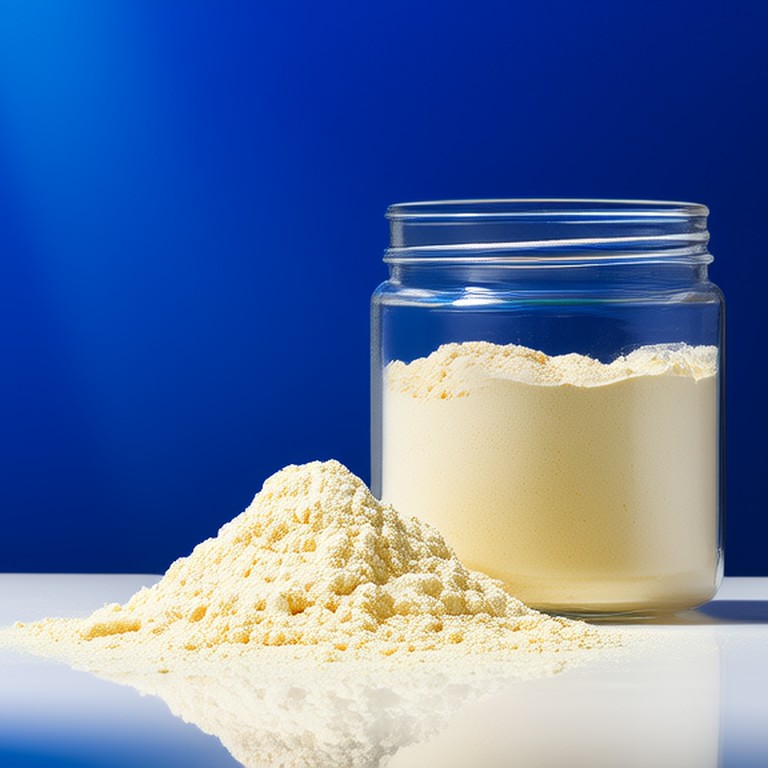
Yeast Protein F80
Fermentation-derived protein powder at 80% minimum on a dry basis, produced from edible yeast. Non-GMO, allergen-free and free from animal inputs – a sustainable protein source for high-protein beverages, plant-based meat and functional foods.
- Active: Protein ≥ 80.0% (dry basis)
- Source: Edible yeast, enzymatic hydrolysis and extraction
- Appearance: Light yellow to yellow powder
- Packaging: 25 kg/carton with aluminium bag PE liner
What Is Yeast Protein F80?
Yeast Protein F80 is an environmentally friendly, sustainable high-quality protein produced from edible yeast through processes such as enzymatic hydrolysis and extraction. It contains over 80% protein on a dry basis with a balanced amino acid profile, and it is supplied as a light yellow to yellow powder with a taste and odour characteristic of yeast.
Because the protein comes from a fermentation process rather than from an animal or a major crop, F80 carries no animal inputs, no declared allergens, no risk of animal pathogenic bacteria contamination and no religious taboos in its composition. That combination is why it is used as a protein base in meat products, dairy beverages, solid beverages, plant-based protein beverages, frozen beverages and plant-based meat.
Key Facts at a Glance
- Protein (dry basis): ≥ 80.0%
- Moisture: ≤ 6.0%
- Total ash: ≤ 6.0%
- Nucleic acid: ≤ 2.0%
- Appearance: Light yellow to yellow powder, no visible foreign impurities
- Taste and odour: Unique to yeast
- Reference standard: In-house standard, verified per batch
- Packaging: 25 kg/carton with aluminium bag PE liner
- Shelf life: 24 months from the production date
- Storage: Well-ventilated, dry environment; ideally ≤ 20 °C and below 60% RH
Origin & Sourcing
F80 is produced by fermenting edible yeast and recovering the protein with enzymatic hydrolysis and extraction, then drying it to a free-flowing powder. Because the raw material is cultivated rather than harvested from animals or a single crop, supply is not tied to whey, dairy, soy or pea chains – an advantage when you are building a second protein source into a portfolio or de-risking a single-origin dependency.
Every batch is released against the in-house specification shown on this page and ships with a COA and MSDS. Commercial volumes are held in stock and quotations are returned against live availability, so ask for the current price and specification sheet before you lock a recipe.
Key Benefits
- 80% minimum protein on a dry basis with a balanced amino acid profile
- Produced from edible yeast – no animal-derived raw material in the supply chain
- Non-GMO origin as declared in the specification
- No allergens declared in the specification, which keeps allergen labelling straightforward
- No risk of animal pathogenic bacteria contamination
- No religious taboos by composition, keeping dietary certification routes open
- Environmentally friendly, fermentation-based protein for sustainability claims
- Supplied as a light yellow to yellow powder in 25 kg cartons with an aluminium bag and PE liner
Applications
The specification covers meat products, dairy beverages, solid beverages, plant-based protein beverages, frozen beverages, plant-based meat and similar applications, added in appropriate amounts according to production needs. In practice that means protein-fortified drinks and ready-to-mix powders, plant-based meat systems, high-protein dairy alternatives, frozen desserts and bakery or savoury systems where a fermentation-derived protein is preferred.
Two formulation notes matter at the bench stage. First, F80 is a protein source, so the inclusion rate follows from the protein target on your label: at 80% protein on a dry basis, roughly 12.5 g of F80 delivers about 10 g of protein. Second, the taste and odour are characteristic of yeast, so beverage and dairy projects should validate flavour masking in a trial rather than assume a neutral background – we supply samples for exactly that purpose.
Why 2026 Matters
Protein fortification keeps expanding beyond sports nutrition into everyday food and drink, and brand owners are diversifying away from a single dairy-based protein source. Yeast protein answers that brief from a different direction: it is fermentation-based, non-GMO and free from animal inputs, so it is not exposed to the same supply and price swings as whey or to the allergen labelling that soy and dairy carry. For 2026 launches, that diversification is the point.
Yeast protein is also one of the few high-protein ingredients that fits both a clean-label story and a cost-sensitive formulation, because the protein content is high enough that it does not need to be carried by a large mass of excipient. If you are planning a protein line for next year, the sensible step is to bench-test F80 now while commercial volumes are in stock.
Science Snapshot
Protein quality is judged on two things: the amino acid profile and how well the protein is digested. Yeast protein is described in its specification as having a balanced amino acid profile, and this grade is standardised at 80% minimum protein on a dry basis, with moisture, total ash and nucleic acid limits defined per batch.
The nucleic acid limit is the parameter buyers overlook most often. Yeast-derived proteins are judged partly on their RNA content, and F80 caps nucleic acid at 2.0%, which is why it can be used at meaningful inclusion rates rather than only as a minor flavour ingredient. Protein content on the label is a separate calculation again: in the EU, protein claims such as "source of protein" and "high protein" are defined by the share of energy that protein contributes to the finished food, so validate the claim against your final recipe and your market’s rules. We supply the specification and documentation your regulatory and R&D teams need for that review.
Quality & Specifications
Released against the in-house standard, with the parameters below reported per batch on the Certificate of Analysis.
Physical & Chemical
| Item | Parameter |
|---|---|
| Protein (dry basis), % | ≥ 80.0 |
| Moisture, % | ≤ 6.0 |
| Total ash, % | ≤ 6.0 |
| Nucleic acid, % | ≤ 2.0 |
Microbiological
| Item | Parameter |
|---|---|
| Total plate count, cfu/g | ≤ 10,000 |
| Mould, cfu/g | ≤ 10 |
| Yeast, cfu/g | ≤ 10 |
| Coliforms, cfu/g | ≤ 10 |
| Salmonella (/25 g) | Not detectable |
| Staphylococcus aureus (/25 g) | Not detectable |
Heavy Metals & Sensory
| Item | Parameter |
|---|---|
| Lead (Pb), mg/kg | ≤ 0.4 |
| Arsenic (As), mg/kg | ≤ 0.3 |
| Cadmium (Cd), mg/kg | ≤ 0.1 |
| Mercury (Hg), mg/kg | ≤ 0.05 |
| Colour and shape | Light yellow to yellow powder, no visible foreign impurities with normal vision |
| Taste and odour | Unique to yeast |
Storage & Packing
- Storage: Store in a well-ventilated, dry environment and use as soon as possible after opening. Ideal condition: temperature ≤ 20 °C, relative humidity below 60%.
- Shelf life: 24 months from the production date.
- Packaging: 25 kg/carton with aluminium bag PE liner.
- Note: Business-to-business ingredient information only. Not intended to diagnose, treat, cure or prevent any disease.
MOQ
- Sample: from 1 kg (freight collect)
- Bulk: from 25 kg (1 carton)
- Tiers: 100 kg / 500 kg / 1,000 kg — tiered pricing on request
Availability & Price
- Stock: Commercial volumes held in stock
- Pricing: Quoted against live availability — request a current quotation
- Ports: Xi’an / Shanghai / Shenzhen, China
Lead Time
- Standard: 15–60 days (by quantity & specification)
- Expedited: 7–15 days (in-stock, small batch)
- Counted from: sample approval + deposit received (next business day)
Protein ingredients are quoted against live availability because market prices move. Send your specification, target quantity and destination and we will return a formal quotation with the current price and lead time.
Safety & Regulatory
F80 is supplied as a food ingredient for further processing. Microbiological limits are specified per batch: total plate count ≤ 10,000 cfu/g, mould, yeast and coliforms ≤ 10 cfu/g, and Salmonella and Staphylococcus aureus not detectable in 25 g. Heavy metals are capped at Pb ≤ 0.4, As ≤ 0.3, Cd ≤ 0.1 and Hg ≤ 0.05 mg/kg.
Permitted uses, labelling and protein claims differ between markets, and the claim on your finished pack depends on your recipe and your inclusion rate. We provide the specification, COA, MSDS and technical data sheet your regulatory team needs, and we will confirm the non-GMO and allergen statements in writing before you file. This page is business-to-business ingredient information and is not medical or regulatory advice.
Formulation Notes
- Dose follows the label: at 80% protein on a dry basis, about 12.5 g of F80 contributes roughly 10 g of protein. Scale that to your target protein content, then adjust for the finished serving size.
- Validate dispersion in your own system: powder behaviour differs between a ready-to-mix drink, a plant-based meat matrix and a frozen dessert, so bench-test the inclusion rate rather than transferring it between formats.
- Plan for the yeast note: the taste and odour are characteristic of yeast. In dairy and beverage applications, run a masking trial at the intended dose before you commit to a flavour system.
- Watch the nucleic acid limit at high inclusion: the 2.0% cap is what allows meaningful inclusion rates, and it is reported per batch, so ask for it on the COA.
- Store and handle like a protein powder: keep the carton sealed, use soon after opening, and store below 20 °C and 60% RH. The aluminium bag and PE liner protect against moisture pickup.
How It Compares
- Yeast protein vs whey: whey is dairy-derived and tied to dairy supply; F80 comes from fermentation, contains no animal inputs and declares no allergens – useful when you want a second protein source that is not exposed to the same chain.
- Yeast protein vs soy and pea: soy is a declared allergen in the EU and the US, and plant proteins carry crop and harvest variability. F80 is fermentation-based with an in-house specification, so the profile is set by the process rather than the season.
- Yeast protein vs yeast extract: they are different products. Yeast extract is used mainly for flavour; F80 is specified as a protein source at 80% minimum on a dry basis.
- F80 vs lower-protein yeast grades: a higher protein content means less carrier mass to move and label. If your target is a high-protein claim, the higher grade usually wins on cost per gram of protein delivered.
- Protein content vs protein claim: ingredient specifications are quoted on a dry basis, while finished-product claims are based on the share of energy from protein. Do not transfer one number directly to the other.
Why Choose Our Yeast Protein F80
- ✓ Protein 80% minimum on a dry basis, with a balanced amino acid profile
- ✓ Non-GMO, with no allergens declared in the specification
- ✓ Fermentation-derived: no animal inputs and no religious taboos
- ✓ Nucleic acid capped at 2.0% for meaningful inclusion rates
- ✓ Packed in 25 kg cartons with aluminium bag and PE liner
- ✓ Commercial volumes in stock - quoted against live availability
Frequently Asked Questions (FAQ)
What is the protein content of Yeast Protein F80?
80.0% minimum on a dry basis, released against the in-house standard and reported per batch on the Certificate of Analysis.
What is it made from?
Edible yeast, processed through one or more steps such as enzymatic hydrolysis and extraction to recover the protein.
Is your yeast protein non-GMO?
Yes. The specification declares a non-GMO origin, and the statement can be confirmed in writing for your documentation file.
Does it contain allergens?
No allergens are declared in the specification for this grade. Because allergen labelling rules differ between markets, we recommend confirming the statement against your own finished-product labelling review – we issue it in writing on request.
Is it suitable for vegetarian and religious-dietary programmes?
The protein comes from edible yeast rather than animal material and carries no religious taboos in its composition, which keeps dietary certification routes open. Certification itself is issued separately; tell us your requirement and we will confirm what is available.
What are the microbiological and heavy-metal limits?
Total plate count ≤ 10,000 cfu/g; mould, yeast and coliforms ≤ 10 cfu/g; Salmonella and Staphylococcus aureus not detectable in 25 g. Heavy metals: Pb ≤ 0.4, As ≤ 0.3, Cd ≤ 0.1 and Hg ≤ 0.05 mg/kg.
Why does the nucleic acid limit matter?
Yeast-derived proteins are assessed partly on their RNA content, and F80 caps nucleic acid at 2.0%. That limit is what allows the ingredient to be used at meaningful inclusion rates rather than as a minor component.
What is the MOQ and sample size?
Samples start at 1 kg (freight collect) and bulk orders from 25 kg – one carton. Tiered pricing applies from 100 kg, and commercial volumes are held in stock.
How is it packaged and stored?
25 kg/carton with an aluminium bag and PE liner. Store in a well-ventilated, dry area at 20 °C or below and under 60% RH, use as soon as possible after opening, and expect a 24-month shelf life from the production date.
Which applications is it used in?
Meat products, dairy beverages, solid beverages, plant-based protein beverages, frozen beverages, plant-based meat and similar applications, added in appropriate amounts according to production needs.
Can I get a sample and the full documentation?
Yes. Ask for the specification sheet, COA format and MSDS, and we will send a sample for bench trials – usually shipped within 1-3 working days.
How to Get Started
- Tell us your format and target protein content – drinks, plant-based meat, dairy alternative or a powder blend.
- We confirm the grade, send the specification sheet and a free sample from stock.
- Bench-test at your inclusion rate; we lock the COA and lead time on approval.
- Scale to commercial volumes with batch-to-batch consistency guaranteed.
Ready to Source Yeast Protein F80?
Tell us your specification, application and quantity — we reply within 24 hours.
What you can expect from Core Nutrix
- Every batch released against the specification you approve, with a full COA (assay by HPLC/UV, heavy metals, microbiology, residual solvents, pesticide residue screened to EU MRLs).
- Free samples with COA and MSDS - freight collect, credited against your first bulk order.
- Third-party test reports, allergen and GMO statements, shelf-life and stability data supplied on request.
- Documentation support for your market entry: EU Regulation (EC) No 1924/2006 on nutrition and health claims, US 21 CFR 101.93 structure/function support, California Proposition 65 statements.
- One working day to a quotation, OEM/ODM projects from 100-500 kg, private label, custom specifications and packaging.
This is technical, business-to-business information for manufacturers and brand owners - not a consumer label and not medical advice. Where a claim is made about a finished consumer product, it must comply with the rules of the destination market; we supply the supporting technical documentation so your team can review it. Ask us for anything your market requires - we are glad to help.